
This under the sea 3rd grade weekly plan gives you a simple way to organize your week using a fun ocean theme.
It’s part of a 36-week 3rd grade homeschool curriculum, with each week built around a different theme to keep learning feeling fresh and interesting.
This week focuses on spelling, vocabulary, and language skills, with math worksheets coming soon.
Science and social studies worksheets will also be added over time. For now, I’ve included simple science and social studies plans to help you build out the theme for the week.
New worksheets and activities will continue to be added to this week over time.
Jump to:
- Spelling
- Reading Book Ideas
- Science
- Social Studies
- Math worksheets coming soon
Weekly Plan
Here is the outline for the 5-day weekly plan. The details for each subject can be found below. You can also add your own themed ideas and activities to customize your homeschooling week.
Day 1
- spelling: worksheet page 1
- reading
- science
- social studies
- math
Day 2
- spelling: worksheet page 2
- reading
- science
- social studies
- math
Day 3
- spelling: worksheet page 3
- reading
- science
- social studies
- math
Day 4
- spelling: dictation sentences 1-5 (handwriting)
- reading
- math
- art: how to draw a shark
Day 5
- spelling: dictation sentences 6-9 (typing)
- field trip day – one suggestion: visit an aquarium
Spelling
Spelling Words for the Week
This week uses a math themed spelling list:
- measure
- length
- width
- inches
- thick
- thin
- perimeter
- area
- equal
- mile
- divide
- group
You can view the full year 3rd grade spelling list here.
Under the Sea Spelling Worksheets
This week’s spelling worksheets use an under the sea theme to make the activities feel more fun.
The worksheets include a mix of activities designed to keep things feeling varied while still reinforcing important skills.
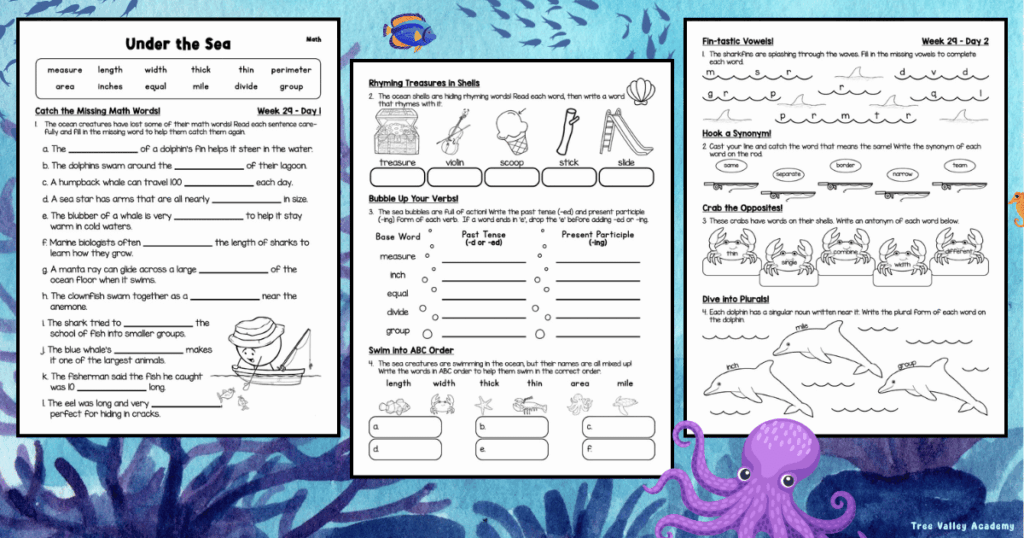
Skills practiced include:
- spelling and vocabulary
- reading and using context clues
- rhyming words
- verb tenses (-ed and -ing)
- synonyms and antonyms
- alphabetical order
- plural nouns
- missing vowels
View and download the full spelling worksheets here.
Dictation Sentences
The dictation sentences are available here. Scroll to “Week 29 Math”.
Only previously learned spelling words and the weekly spelling words are included in the dictation sentences.
Day 4 – Handwriting
Use this time to focus on handwriting, punctuation, and spelling.
It’s ideal to have a double-lined notebook for kids to write their dictation sentences each week. Make sure they know to try to print their letters neatly.
Day 5 – Typing
For kids who need a lot of variety to stay engaged, day 5 dictation sentences can be typed. This is faster also since it’s a field trip day.
What I did with my daughter was give her a phone to text me each sentence I dictated. This didn’t feel like school work to her so it got done quite quickly.
If she made a mistake, with punctuation or spelling, I’d let her know where her mistake was, and she’d text me back the word or punctuation in question.
Ocean Themed Books
If you want to build around the theme, here are some ocean-themed books that work well for this age:
- Magic Tree House: Dolphins at Daybreak by Mary Pope Osborne
- Shark Lady by Jess Keating
- National Geographic Kids: Ocean Life
- Sea Turtles: National Geographic Kids Readers, Level 2
- Who Would Win? Whale vs. Giant Squid by Jerry Pallotta
These can be used for read-aloud time, independent reading, or just as a way to add a little more to the week.
Science
This week includes a simple science plan that fits the Under the Sea theme.
More printable science worksheets are coming soon, but this gives you a clear way to cover key Grade 3 science skills using the theme.
Many weeks include lighter science, but this is one of the more science-focused weeks.
Main Topics
This week focuses on:
- Ecosystems
- Food chains & food webs
- Animal adaptations
- Ocean habitats
Life Science
Ecosystems
- Identify an ocean ecosystem
- Describe how living and nonliving things work together in an ecosystem
- Understand roles: producers (seaweed, algae); consumers (fish, sharks); decomposers
Food Chains & Food Webs
- Build a simple ocean food chain
- Understand how energy flows (sun → plant → animal)
- Interpret a basic food web
For a deeper understanding:
- Explain what happens if one organism is removed
Adaptations
- Identify ocean animal adaptations:
- gills
- fins
- camouflage
- body shape
- Explain how adaptations help survival
Earth & Environment
Habitats
- Understand basic ocean zones (shallow vs deep water)
- Recognize that environments affect survival
Science Skills
- Interpret simple diagrams (food chains/webs)
- Make predictions (What happens if…?)
- Explain cause and effect
End of the Week Goal:
By the end of the week, students should be able to:
✔ Explain how ocean animals depend on each other
✔ Build and explain a simple food chain
✔ Identify adaptations and explain how they help survival
✔ Predict what happens when part of an ecosystem changes
3 Day Science Plan
Here’s a simple 3-day plan you can follow:
DAY 1: Ocean Ecosystems + Food Chains
Focus:
- What is an ocean ecosystem?
- Who lives there?
- How living things depend on each other
Teach:
- Living vs nonliving (water, sunlight, sand)
- Introduce:
- Producers (algae, seaweed)
- Consumers (fish, sharks)
- Build a simple food chain:
- sun → algae → small fish → big fish
Activities:
- Sort ocean items (living vs nonliving)
- Cut-and-paste or draw a food chain
- Label producer and consumer
Goal:
✔ Students understand that ocean life is connected
✔ Your child can build a simple food chain
DAY 2: Food Webs + “What If” Thinking
Focus:
- How animals are connected (not just one chain)
- Cause and effect in ecosystems
Teach:
- Show how multiple food chains connect → food web
- Explain that animals depend on more than one food source
Key Thinking Questions:
- What happens if small fish disappear?
- What happens if sharks disappear?
Activities:
- Look at a simple ocean food web
- Answer “What if…” questions
- Circle or trace connections between animals
Goal:
✔ Students understand that ecosystems are interconnected
✔ Students can explain simple cause and effect
DAY 3: Adaptations + Survival
Focus:
- Why ocean animals look and act the way they do
Teach:
- Introduce adaptations:
- gills (breathing underwater)
- fins (movement)
- camouflage (hiding)
- body shape
Activities:
- Match animals to adaptations
- Explain: “How does this help the animal survive?”
👉 Fun option:
- Design an ocean animal and give it adaptations
Goal:
✔ Students can identify adaptations
✔ Students can explain how traits help survival
OPTIONAL SIMPLE EXPERIMENTS
If you’d like to go a little further, here are a few simple, hands-on activities to help reinforce the science concepts for each day.
DAY 1: Ocean Ecosystems + Food Chains
Simple Experiment: Floating in Salt Water
What you need:
- 2 clear cups
- Water
- Salt
- 2 small objects (like grapes or small toy items)
What to do:
- Fill both cups with water
- Add salt to one cup and stir
- Place the same object in each cup
What to observe:
- Does the object float or sink in each cup?
Talk about it:
- The ocean is salt water, which can help some things float
- Ocean conditions affect how living things survive
👉 Simple connection:
Even small differences in an environment can affect what lives there
DAY 2: Food Webs + “What If” Thinking
Simple Experiment: Removing a “Species”
What you need:
- Small objects or pictures (representing ocean animals)
(example: algae, small fish, big fish, shark)
What to do:
- Set up a simple “food chain” using the objects
- Remove one (for example: the small fish)
What to observe:
- What happens to the other animals?
Talk about it:
- What does the big fish eat now?
- What happens to the algae if nothing eats it?
👉 Simple connection:
Ecosystems are connected—when one part changes, everything is affected
DAY 3: Adaptations + Survival
Simple Experiment: Camouflage Challenge
What you need:
- Colored paper (blue, green, or patterned)
- Small paper “fish” (different colors)
What to do:
- Place the paper fish on different backgrounds
- Ask your child to find them as quickly as possible
What to observe:
- Which fish are hardest to see?
Talk about it:
- Some animals blend into their environment to stay safe
- This is called camouflage
👉 Simple connection:
Adaptations help animals survive in their environment
Social Studies
You can easily add a simple social studies connection to your Under the Sea week by focusing on:
- oceans
- natural resources
- how people interact with the environment
At this level, kids are not expected to memorize detailed geography. The goal is to:
- become familiar with the five oceans
- understand how oceans are used by people
- begin thinking about how we care for the environment
Day 1: Oceans of the World
Focus: Basic geography
Introduce the five oceans:
- Pacific
- Atlantic
- Indian
- Arctic
- Southern
Use a map or globe to:
- point out where the oceans are
- notice how they connect around the continents
- see how much of Earth is covered by water
Kids don’t need to memorize exact locations. The goal is to recognize the names and start identifying them on a map.
Simple questions to ask:
- Which ocean is closest to where we live?
- Why are oceans important?
- How do people travel across oceans?
Day 2: How People Use the Ocean
Focus: Resources and economy
Talk about how oceans are important to people around the world.
Cover a few simple examples:
- food (fishing)
- transportation (ships moving goods)
- jobs connected to the ocean
You can introduce natural resources in a simple way:
- fish
- salt
- oil (basic mention only)
Simple questions to ask:
- What foods come from the ocean?
- How do goods travel between countries?
- What jobs might people have near the ocean?
Day 3: Protecting Our Oceans
Focus: Citizenship and environment
Talk about how people affect the ocean and why it matters.
Keep it simple and age-appropriate:
- pollution (trash in water)
- protecting animals
- taking care of natural resources
Simple questions to ask:
- What happens if oceans get polluted?
- Why should we protect ocean animals?
- What can we do to help?
Extend the Theme (Optional Ideas)
If you’d like to go beyond worksheets, here are a few simple ways to extend the theme:
- practice measuring objects around the house
- how to draw a shark activity
- watch an ocean documentary clip
- visit an aquarium (if possible)
- build a 3D ocean food chain
Share Your Ideas
If you try this under the sea week, I’d love to hear what you added to it.
Did you find a great ocean-themed book, try a fun science activity, visit an aquarium, or come up with another hands-on idea? Feel free to share it in the comments below so other parents and teachers can use your ideas too.
Every family ends up putting their own spin on these themes, and your suggestions could help make the week even more fun for someone else.