
This shapes 3rd grade weekly plan will help you plan a full homeschool week using a fun geometry and shapes theme.
The plan for the week includes:
- a spelling list
- spelling worksheets (coming in the next couple days)
- math worksheets
- science activities
- social studies lessons
- themed reading ideas
This plan is part of a 36-week 3rd grade homeschool curriculum. Each week has a different theme to keep learning fun and fresh.
In the future, I will add science and social studies worksheets. But for now, I’ve shared a simple lesson plan along with the skills to cover this week.
New worksheets, word puzzles, and activities will continue to be added as they are created.
Jump to:
Day by Day Plan
Here is a simple outline for your 5-day homeschool week. You can easily adjust the schedule to fit your family.
Day 1
- spelling worksheets page 1 & 2
- reading
- math worksheets
- science
- social studies
- art: draw animal or cartoon character shape by shape (see book ideas)
Day 2
- spelling worksheet page 3
- reading
- math worksheets
- science
- social studies
- art: draw animal or cartoon character shape by shape (see book ideas)
Day 3
- spelling worksheet page 4
- reading
- math worksheets
- science
- social studies
- art: draw animal or cartoon character shape by shape (see book ideas)
Day 4
- spelling dictation sentences (handwriting)
- reading
- art: draw and label different 2D and 3D shapes
Day 5
- spelling dictation sentences (typing)
- hands-on shape scavenger hunt
- field trip idea: visit a playground, museum, or architecture walk to spot shapes in real life
Spelling
Spelling List for the Week
This week uses a shape-themed spelling list:
- shape
- circle
- square
- rectangle
- triangle
- cube
- sphere
- cone
- oval
- cylinder
- heart
- pyramid
Shape Spelling Worksheets
The spelling worksheets for this week can be downloaded here:
3rd grade shape spelling worksheets
The worksheets are art themed.
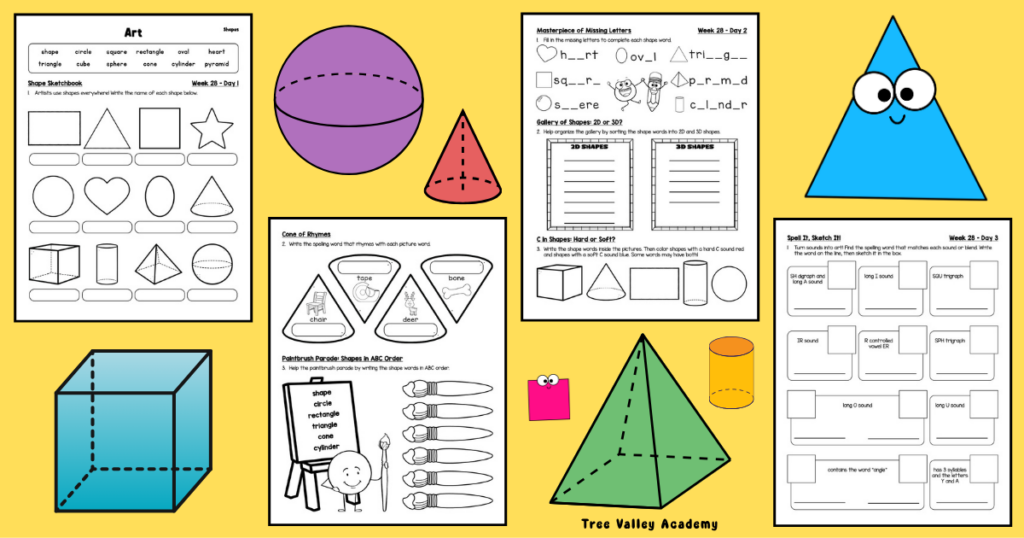
Besides learning the spelling words for the week, kids will practice language art skills like:
- spelling and shape vocabulary
- rhyming words
- alphabetical order
- missing letters
- identifying 2D and 3D shapes
- hard and soft C sounds
- digraphs and trigraphs
- long vowel sounds
- R-controlled vowels
- syllables
- recognizing spelling patterns
- matching sounds to words
- reading phonics clues
- drawing and visualizing vocabulary words
Dictation Sentences
The dictation sentences are available here. Scroll to “Week 28 Shapes”.
Only previously learned spelling words and the weekly spelling words are included in the dictation sentences.
Day 4 – Handwriting Practice
Use day 4 to slow down and focus on neat handwriting, punctuation, and careful spelling.
A double-lined notebook works really well for weekly dictation practice. Encourage your child to take their time forming letters neatly and remembering proper capitalization and punctuation.
This is also a good opportunity to practice writing complete sentences clearly and carefully.
Day 5 – Typing Practice
For day 5, try switching things up with typing practice instead of handwriting. This can be especially helpful for kids who enjoy technology or need a little extra variety during the week.
Since many families use day 5 as a lighter homeschool day or field trip day, typing can make dictation practice feel quicker and more relaxed.
One fun option is to dictate sentences while your child types them into a text message, document, or note-taking app. Because it feels different from regular schoolwork, kids are often more motivated to complete the activity.
If mistakes are made with spelling or punctuation, simply point out where the error is and let your child correct it independently.
Book Ideas
Here are a few shape and geometry themed books that work well for this week:
- Drawing Shape by Shape: Create Cartoon Characters with Circles, Squares, and Triangles (Volume 1)
- Drawing Animals Shape by Shape by Christopher Hart
- The Greedy Triangle by Marilyn Burns
Other types of books that might work well for this week are:
- architecture books for kids
- engineering books
- bridge/building books
- STEM challenge books
Math
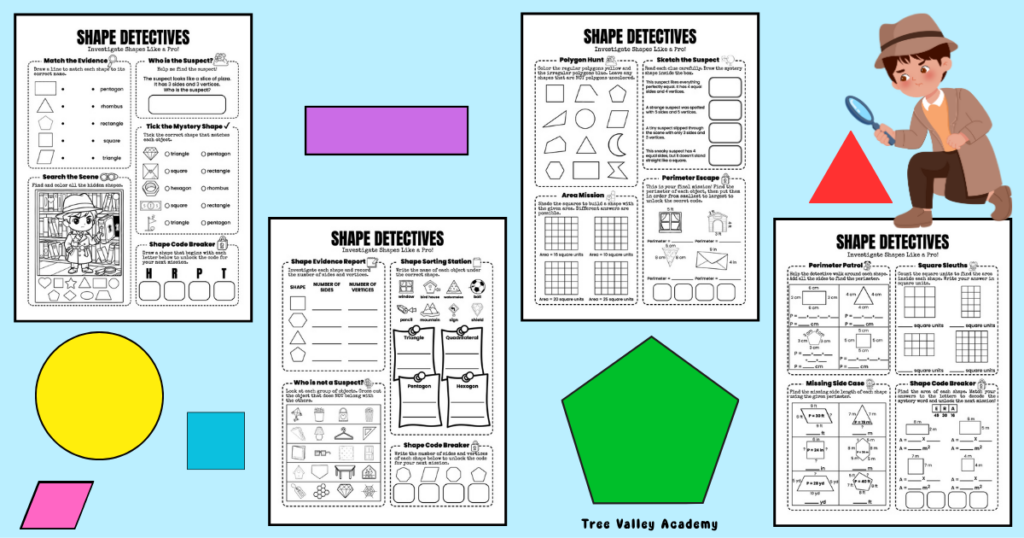
The math worksheets for this week are available here:
3rd Grade Shapes Math Worksheets
Science
Science worksheets will be created for this week.
Until then, here is a simple plan that will guide you in covering the Grade 3 science skills for the week. The lessons are all related to our shapes theme.
Shapes are everywhere in science, engineering, and nature, making this an easy theme for hands-on learning.
Main Topics:
- structures and stability
- materials and properties
- simple engineering design
- observation and problem-solving
Skills Covered:
- identify properties of materials: hard, flexible, smooth, rough, strong
- compare materials
- choose materials for a purpose
Structures & Stability
- understand that shapes affect strength
- explore how shapes help structures stay stable
Slightly advanced: compare why some shapes are stronger than others in buildings and bridges
Engineering & Science Skills – Problem Solving
- Test ideas
- Improve designs
- Compare solutions
Observation Skills
- observe shapes in the real world
- identify patterns in structures
End of the Week Goal
Students should be able to:
✔ identify properties of materials
✔ explain how shapes can make structures stronger
✔ compare different design ideas
✔ build and test a simple structure
3 Day Science Plan
Day 1: Shapes in Structures
Focus:
- how shapes are used in real life
- strong vs weak shapes
Teach:
- shapes are used in buildings, bridges, towers, signs, and everyday objects
- some shapes help structures stay strong
- introduce: triangles, squares, rectangles, circles
- discuss how shapes help engineers and builders create strong structures: ex. triangles in bridges; cylinders in towers; cubes in buildings
- talk about shapes found in nature: honeycombs, spider webs, crystals, flowers, turtle shells. Ask:
- Why do you think these shapes appear in nature? Which shapes are strongest? What shapes repeat in patterns?
- find shapes in real-world structures
- compare which shapes seem strongest
- draw or label shapes in buildings or bridges
Activities:
Goal:
✔ students recognize shapes in structures
✔ students understand shapes can affect strength and stability
Optional Experiment: Strong Shapes
What you need:
- paper strips
- tape
- small books or objects
What to do:
- fold paper into different shapes: triangle, square, cylinder
- test which shape holds the most weight
What to observe:
- which shape stays strongest?
Talk about it:
- engineers use shapes to make structures stronger
Simple connection: different shapes can change how strong a structure is
Day 2: Materials & Design
Focus:
- choosing materials for a purpose
Teach:
- different materials have different properties
- engineers choose materials carefully
- examples: metal, wood, plastic, fabric
Activities:
- compare materials
- sort by properties
- decide which materials would work best for different objects
Example:
- Which material would make the best umbrella?
- Which material would make a strong bridge?
Goal:
✔ students can compare material properties
✔ students understand materials are chosen for specific purposes
Optional Experiment: Waterproof Test
What you need:
- small pieces of different materials: paper, fabric, plastic, foil, water
What to do:
- put a few drops of water on each material
- observe what happens
What to observe:
- Which materials absorb water?
- Which materials repel water?
Talk about it:
- some materials work better for certain jobs
Simple connection: materials have properties that affect how they are used
Day 3: Engineering Challenge
Focus:
- designing and improving structures
Teach:
- engineers solve problems by testing ideas
- designs can be improved
- introduce: planning, testing, improving
Activities:
- build a simple tower or bridge
- test strength or stability
- improve the design
Goal:
✔ Students can test and improve a design
✔ Students understand simple engineering thinking
Optional Experiment: Build a Strong Tower
What you need:
- marshmallows or clay
- toothpicks or straws
What to do:
- build a tower using shapes
- test how tall or stable it is
- try improving the design
What to observe:
- Which shapes help the tower stay stable?
Talk about it:
- engineers test and improve designs many times
Simple connection: strong designs often use shapes that improve stability
Social Studies
This week’s social studies lessons focus on maps, landforms, and geography connections related to shapes and regions.
At a future date, I will create printable worksheets for this week’s lesson. But until then, I’ve added a guide to help you cover the 3rd grade social studies skills.
At this level, kids are learning to recognize how maps and regions use shapes, symbols, and patterns to organize information.
This can easily be done with 2-3 short lessons during the week.
Day 1: Shapes on Maps
Focus: Geography and map skills
Look at a map and notice different shapes:
- countries
- provinces or states
- lakes
- islands
Talk about how maps use shapes to represent real places.
Kids do not need to memorize locations. The goal is simply to become comfortable observing and discussing maps.
Simple questions to ask:
- What shapes do we notice on maps?
- Why are no two countries exactly the same shape?
- How do maps help people understand places?
Day 2: Symbols and Patterns
Focus: Mapping and communities
Introduce common map symbols:
- roads
- parks
- schools
- rivers
You can also discuss simple patterns found in communities:
- grid streets
- neighborhoods
- building layouts
The goal is to help kids recognize how communities are organized.
Simple questions to ask:
- Why do maps use symbols?
- What patterns do we notice in communities?
- How can maps help people travel?
Review:
- map keys
- compass directions
Day 3: Landforms and Regions
Focus: Geography and environment
Talk about the shapes of natural landforms:
- mountains
- rivers
- islands
- valleys
Discuss how landforms can affect:
- transportation
- homes
- communities
Simple questions to ask:
- How do landforms affect where people live?
- Why are some cities built near rivers or coastlines?
- How can geography affect communities?
Optional Simple Activities
If you’d like to make this week more hands-on, here are a few easy ideas:
- Map Symbol Activity:
Create a simple legend using symbols. - Neighborhood Map:
Draw a basic map of a neighborhood or classroom. - Landform Match:
Match pictures of landforms to their names.
More Hands-On Geometry Ideas
If you’d like to add a few extra activities this week, try:
- building 3D shapes with toothpicks and marshmallows
- making shape art pictures
- going on a shape scavenger hunt around the house or outdoors
- Look for shapes in buildings around town
- Visit a playground and discuss structure design
- Build a paper bridge challenge
- build simple structures using: blocks, LEGO, paper rolls
- make shape cookies
- create tangram puzzles
- build a cardboard city using 3D shapes
- practice measuring area and perimeter with graph paper
These activities help geometry feel practical and fun.
Ready for the next week? See the plan for week 29 here.
Or go back to the full plan for all 36 weeks of the 3rd grade homeschool curriculum.
Share Your Ideas
If you use this shapes week in your homeschool, I’d love to hear how it went.
Did your child enjoy a fun geometry activity, build something with 3D shapes, find shapes on a nature walk, or discover a great shape-themed book? Share your ideas in the comments below so other homeschool families can try them too.
One of my favorite things about themed learning is seeing all the creative ways families make each week their own. Your ideas may inspire someone else planning their own shapes week.